
Deprogramming Our Deprogramming


One morning, early in January, Americans woke up to somewhat unexpected news. The night before, the U.S. military had gone into Venezuela and extracted Nicolas Maduro and his wife, Cilia Flores. Of course, there had been rumblings that something would be going down with Venezuela, probably sooner rather than later, but while many speculated as to what that would look like, no one knew the timing, and (as far as I am aware) no one considered this particular scenario.
To say this sent waves through both the faux and real MAGA community is an understatement. This move, by Trump, put much of MAGA in a bit of a rhetorical pickle. After the Forever Wars in Afghanistan and Iraq, many (perhaps most) within MAGA had taken an anti-regime change and anti-war stance. It isn’t America’s job to police the evil dictators of the world, and we don’t seem to be much good at it anyway; we should just mind our own business and take care of ourselves. So when Trump decided to swoop into Venezuela one night and pluck their communist dictator out of his bed, this caused some conflict within MAGA.
Immediately (because, why wait when a knee-jerk reaction gets you more engagement on social media?), people both in favor and against it came out in full force. Much of the ensuing discussion (and ranting and name-calling) revolved around the question of whether or not this was an actual regime change, with those who were opposed to the act calling it regime change, and seemingly using that as their sole metric for deciding it was wrong, and those who were in favor putting on an Olympic-worthy performance of mental gymnastics to try to explain how it wasn’t actually regime change and thus they can be ok with it.
While the debate raged for a time, it was a relatively short time, as it quickly became clear that this move was not, in fact, the end of the world. This, combined with anti-ICE protests in Minnesota and the release of the Epstein files, pushed the whole ordeal into the background.
Fast forward to the end of February, and once again, Americans found themselves waking up one morning to unexpected news: the U.S. had begun a military operation against Iran. This move also seemed to surprise many people, perhaps even more so than Venezuela had, even though, just as with Venezuela, there had been signs this was coming. Trump had been lobbing heated words at Iran for months (years, well, decades really), U.S. naval ships were amassing in the Gulf, and Mike Huckabee (U.S. ambassador to Israel) had strongly urged embassy staff to leave Israel. Yet, even on the eve of the attack, there were people saying, “It’ll never happen.”
But it did happen, and once again MAGA found itself back in that same rhetorical pickle it had been in when Trump scooped up Maduro. And just as with the Venezuela situation, MAGA quickly divided into camps of being for or against this move.
As mentioned above, those who are against military action in Iran (or, for that matter, regime change in Venezuela) and a sizable subgroup of those in favor of that same military action share a common ideology: they are both anti-war. Or, at least, they both say they are anti-war.
Now I think it is easy to spot the issue with people saying they are anti-war or anti-regime change while supporting Trump’s moves in Venezuela and/or Iran. When Marudo was extracted, many people in this camp argued that that wasn’t really regime change since the vast majority of the regime remained in place. Another argument was that it wasn’t regime change because Maduro, allegedly, cheated in his last election and was therefore illegitimate. While I do see the points that people were trying to make here, I don’t find them terribly compelling.
The very term “regime” is laden with connotations of illegitimacy, and as such, most regime changes are justified by the supposed illegitimacy of said regime. And while it is true that the majority of Maduro’s regime remains in place, with only him and his wife being removed from the picture, I think that we all understand that Maduro’s former Vice President is only in charge now, because the United States allows it. That is regime change. It may be a less destabilizing regime change than we’re used to seeing, but it is still regime change.
Similarly, many of those same people are now arguing (or at least were arguing at the beginning) that this action in Iran is not a war. To be honest, I have not seen much in the way of clearly laid out reasoning for this position. Some seem to be basing this view on the fact that this has been more of a bombing campaign than a boots-on-the-ground campaign, but that seems like a distinction without a difference. Others seem to be basing this stance, more or less, on the fact that, as of writing this, war has not formally been declared. In a legal sense, they may be correct, but in a practical, real-world sense, I think it is difficult to argue that this is not a war. Multiple countries in the region are now involved (in one way or another), Iran’s navy and air force have been decimated, and the majority of their senior leadership has been killed, with their current leader appearing to be a cardboard cutout. If that is not considered war, then I’m not sure what would be.
Others have made what I see as a more salient point. Rather than arguing that this isn’t a war, they argue that this is a war, but Iran started it. This is a long-overdue response to 47 years of aggression that goes all the way back to (but is not limited to) the Iran hostage crisis of 1979. Iran started this, and instead of sufficiently answering that aggression decades ago — nipping the threat in the bud rather than letting it fester for nearly half a century — administration after administration after administration has chosen to either ignore or appease the country that kills and kidnaps U.S. citizens while chanting “death to America.”
This brings me to my issues with the anti-war-with-Iran crowd. In response to those who support this action (whether or not they are willing to call it war), I have seen a lot of bad-faith argumentation and just straight-up bullying in what seems to me to be an attempt to get these “warmongers” back in line.
Take the argument that this is a war, but one that Iran, not the U.S., started. One can disagree with this line of reasoning, but it is an ideologically consistent thought. For most people who say they are anti-war, they are actually saying they are against non-defensive wars; few are true pacifists. Thus, this war, which they see as a response to aggression, is, in their view, defensive in nature and justified. Perhaps because this argument is ideologically consistent, it has made some on the side opposed to Operation Epic Fury, well, furious. If someone takes this stance, it can’t just be a stance that the anti-Operation Epic Fury (OEF) crowd disagrees with. No, it is actually, according to Con Inc golden boy and Curmudgeon in Chief Matt Walsh, gaslighting:
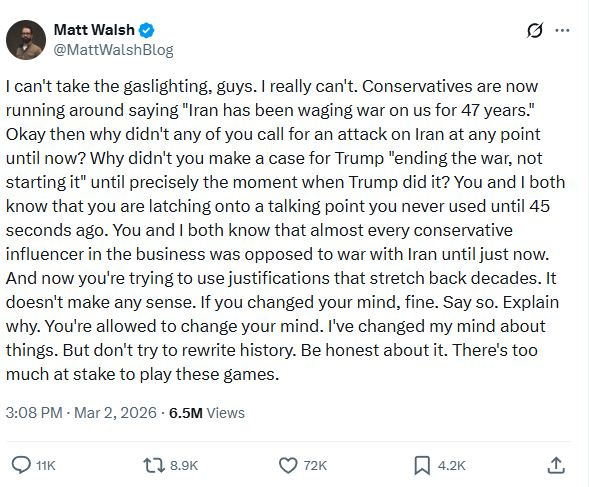
The irony (hypocrisy? I always get those two mixed up) should not be lost on any of us that this post is, in and of itself, gaslighting. Setting aside the fact that someone can be in favor of something without making that thing the number one issue that they constantly talk about, many conservatives have had and have expressed long-standing concerns about Iran, including (as many in his replies pointed out) Matt Walsh himself and (more importantly) Donald J. Trump. Trump has been consistently sounding the alarm on Iran since the ‘80s and calling for military action against it. This isn’t a new stance for him, and anyone who has paid any attention at all should not be surprised, much less feel betrayed, by his willingness to use military force against Iran.
As a side note, did you catch this little gem in the middle of Walsh’s meltdown:
“You and I both know that you are latching onto a talking point you never used until 45 seconds ago. You and I both know that almost every conservative influencer in the business was opposed to war with Iran until just now.”
This is a telling look into Walsh’s perspective. Influencers have (ostensibly) been opposed to war with Iran. While it is true that some of his fellow influencers are pushing back against him, the majority of the pushback is not coming from influencers. His reply section is filled to the brim with everyday Twitter users disagreeing with him; I had to scroll through dozens of replies to this post to find anyone agreeing with him. These are just normal conservative, MAGA people (well, as normal as anyone who spends their time fighting with influencers on social media can be). And I think this may be one of the reasons we’re seeing many influencers who are against this war losing their ever-loving minds.
As far as I can tell, this move against Iran is actually pretty popular with much of MAGA. So, a whole bunch of influencers just found out that they don’t actually have as much influence as they thought they had. I’m sure that is quite jarring for them. After all, you and I are supposed to get our opinions from them. They know more than us. They are better at debating than us. They have secret, anonymous inside sources. They’ve had very important people on their shows and have been invited to events at Mar-a-Lago (never mind that most of those events were not actually hosted by Trump). They spend their days reading articles from the MSN, but not just any MSN, the international MSN, which makes them experts on geopolitics. They are the arbiters of facts and the paragons of morality, so how dare people disagree with them?
And yet, many do dare. As a result, Matt Walsh and many other influencers (both big and small) are crashing out.
Influencers realizing their own irrelevancy aside, this attempt to browbeat supporters of this war into submission has been a prevalent tactic from the anti-OEF crowd. It is also often paired with an air of moral superiority as its adherents claim that they (unlike supporters of OEF) are “just being consistent” in their anti-war stance. But is this actually true? In many cases, no.
Back in 2022, when Russia began its war against Ukraine, there were many, especially in the Truther community, who outright defended this move. I saw numerous justifications for Russian aggression: Ukraine potentially joining NATO was a threat to Russia. Allegedly, Ukraine had been persecuting its Russian ethnic minority community. The people of Crimea had voted to leave Ukraine and join Russia, a decision that Ukraine refused to honor. Putin was cleaning out the “real Nazis” from Ukraine. Etc. It also didn’t help that Zelenskyy acted like an insufferable, entitled git, which put up the hackles of even Americans who were against Russian aggression in Ukraine.
Now, this is not meant to be an argument either in favor of or against Russia’s attack on Ukraine. The point is that there are people who are currently claiming to be anti-war, who have spent years justifying Putin’s aggression. And they justify it even though it is not a defensive war because Ukraine did not strike first.
We see similar arguments when it comes to Israel. There is no doubt that a significant portion of the anti-OEF crowd is also anti-Israel, often rabidly so. As such, many of these same people who are claiming to be anti-war have justified Palestinian (Hamas) aggression against Israel. I don’t think it is going out on a limb to say that some or many of these people would not be so staunchly anti-war or anti-regime change if it were Israel in question. In fact, I know it is not going out on a limb, because people have actually stated that:
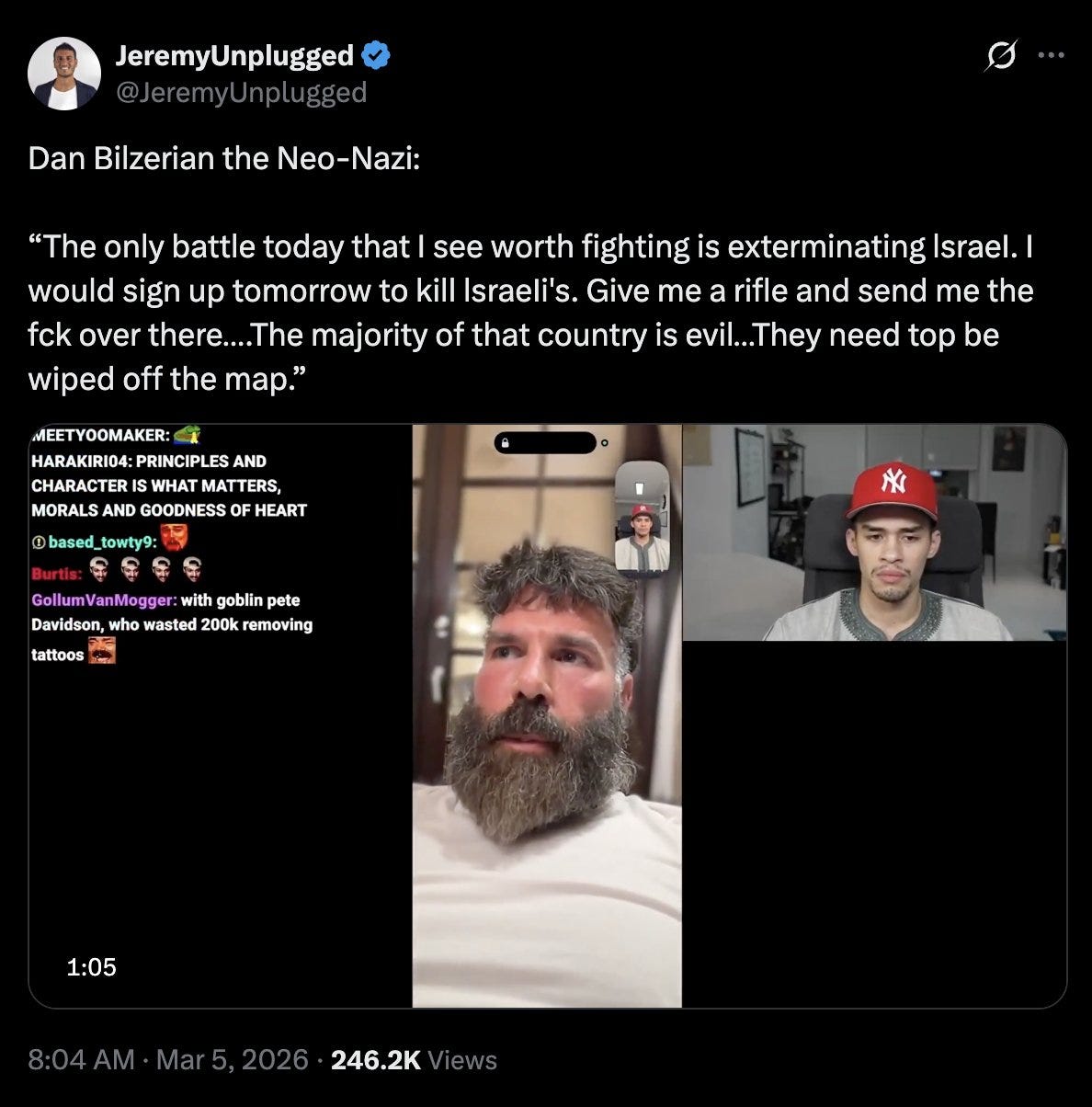
I would post the link to this original post, but Twitter removed it, because censorship that conveniently acts as covering up for, shall we say, controversial users is what Twitter does best (they have done the same for Andrew Tate and many of his self-incriminating Tweets). However, they haven’t deleted this one (as of writing this):
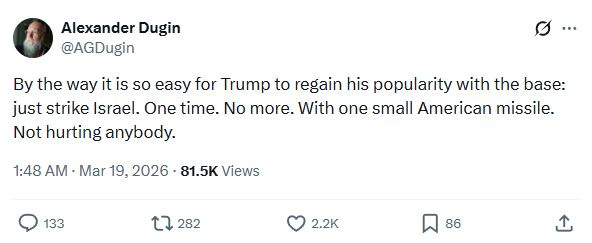
Granted, Dugin is Russian, so not exactly MAGA, but he has been an influence on certain so-called America First circles. He is speaking for a portion of this supposed anti-war crowd.
Others are promulgating conspiracies that this attack on Iran is actually a super sneaky way for Trump to get at Israel, which will result in Israel's surrender.
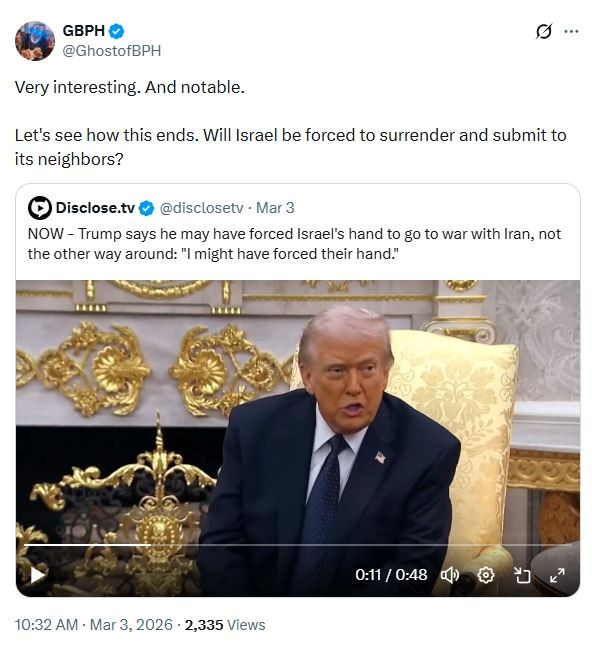
If this theory is true, it would mean that Trump “started a war with Iran” (wink, wink) as a way to indirectly start a war with Israel (in a cowardly, underhanded way, that would also make America look weak). And the implication is that this is a good thing.
Oh yes, a very principled anti-war stance.
Now, lest I paint with the same broad brush that many in the anti-OEF crowd have painted the pro-OEF crowd with, I am not saying that everyone who is against this war is a hypocrite. I am sure there are those who have consistently been against war and/or are only in favor of purely defensive moves. If you’re one of those, then this isn’t about you. I may not agree with you (and I’ll get into why in a bit), but I can respect your point of view as being consistent. However, I have seen, with my own eyes, many people who are currently raging against this war spend years defending not just other wars and aggression, but defending the side that unquestionably was the aggressor. And now those same people are acting as though they are the morally consistent ones.
This isn’t to excuse anyone still trying to claim that what happened in Venezuela and what is currently happening in Iran aren’t actually regime change or war. That is, at best, a delusional stance and, at worst, outright hypocrisy. No, the point is that a significant portion of people, on both sides of these issues, are claiming to be anti-war when, in reality, they are not. So maybe we should all stop pretending to be anti-war and take some time to examine that stance. More importantly, maybe we should be asking why we took that stance to begin with.
There is little doubt that most of the anti-war portion of MAGA took on that stance due to, in large or in whole, the disasters of the Bush/Obama Forever Wars. Many felt they had been duped, in one way or another, into supporting those wars. They felt they were lied to about how long those wars would last. They were lied to about the purposes and desired outcomes of those wars. Others felt duped when they voted for Obama under the belief that he would get us out of those wars. Regardless of how people felt about the wars at the beginning, long before we reached the end, most had decided that, regardless of the validity (or lack thereof) of the reasons, the cost had been far too high. This feeling was exasperated by first Obama and then later Biden pulling us out of those countries in what seemed to be purposefully botched ways that undid much, if not all, of what little had been accomplished.
Clearly, our soldiers and countless innocents were being fed to the war machine, and for what? Nothing. In response to all this, many threw up their hands and said, “No more wars!” And I was one of those.
Then Trump won in 2016.
Over the following year or two, I became aware of the realities of the Deep State and the Globalists, and, in turn, became convinced that while Trump absolutely wants to restore America to greatness, he equally wants to destroy the Globalist Cabal (and, indeed, has to if MAGA is to happen). At that point, I found myself softening on my anti-war stance. After all, how do you destroy a Cabal that is embedded in probably every country on Earth, presumably has control of at least some of those countries’ militaries, and has shown itself quite willing to use violence to maintain its power, without a bit of war?
I’ll admit it was a thought that I kept to myself, in part because I was unsure if it was correct, but, if I’m being honest, probably more out of cowardice. Saying, “Hey guys, I’m not sure I’m actually against war,” hasn’t exactly been a popular stance in MAGA circles, especially the more Truther-oriented ones that I inhabit. It’s a stance that will get you called a Neo-Con, warmonger, or worse. Plus, there were so many people theorizing how Trump could overthrow the Cabal without resorting to war, and I genuinely hoped they were right; it’s not like I want war.
But I think all the rationalizing of how we will get through this without any kinetic war, or sometimes just straight up burying of heads in the sand, should have been a bit of a tip-off. When you step back and look at the big picture, the anti-war crowd has been pretty irrational. Why? Could it be because we were psyopped into our anti-war stances?
The Forever Wars of Afghanistan and Iraq were not mistakes. They were not miscalculations of what we were up against. They were not the result of incompetent leaders. They were purposefully botched. I don’t think what I’m saying is revelatory to most of my readers; most of us probably came to that conclusion long ago. And yet, even many of those who recognize that those wars were botched on purpose still decided to go to the unyielding extreme of being anti-war. We saw the manipulation and still fell for it.
Some fell for it so hard that they have taken being anti-war to such an extreme that they will discount aggression against the United States. Venezuela can send drugs that kill tens of thousands of Americans every year and infiltrate our country with gang members who take over apartment complexes, turning our cities into slums, but that doesn’t count. That doesn’t warrant retaliatory action. Iran can attack or use its terrorist proxies to attack us for decades, and then plan to attack us again, and we are supposed to, what, just wait until they do attack us again, potentially killing more Americans, before we can debate about whether or not we should do anything? The same people who say that an illegal alien, who has been living peacefully in the United States for decades, should still be deported (something I agree with) will then turn around and say that we can’t attack regimes for killing Americans if those Americans were killed decades ago. Others will declare that aggressive moves from other countries simply never happened; it’s all fake and gay (unless, of course, it confirms their biases; then it is totally real).
Offensive moves have been ruled unacceptable, while defensive moves are treated as though they are actually offensive, which makes them de facto unacceptable.
Then you bring in the whole anti-Israel hysteria. People, usually calling themselves “America First,” have become so blinded by their hatred of Israel that they can’t abide anything that may be beneficial to Israel, no matter if it may also benefit the United States. Nothing can be America First if it also benefits Israel in any way, shape, or form. This means people are now either turning on Trump or, if they are unwilling to do that (yet), concocting convoluted theories about how every military move Trump makes (and quite a few non-military moves as well) is actually a secret way to get at Israel.
None of this is rational. It isn’t principled. It isn’t moral. It is madness.
I think sometimes we assume that when propaganda and manipulation come into play, the end goal is uniformity of thought. But when I look at the chaos the Deep State seems to be sowing, it seems less like they want everyone to agree and more like they want to divide people into extremes so that they cannot see or act rationally.
I don’t think the Cabal cares as much as we think it does about the labels we apply to ourselves and others. Republican or Democrat, pro-Palestine or pro-Israel, anti-Semitic or Islamophobic, anti-war or pro-war, or apathetic about anything or everything. What the Cabal really wants is for you to be so much in the extreme, so emotionally attached to or repelled by a label, that you abandon rationality, morality, and the ability to judge things based on the circumstances they inhabit rather than on the sensational labels that get attached to them.
So, sometimes, even as we think we are deprogramming ourselves from one way we were manipulated into thinking, we just end up switching out that programming for a different version. Many of us thought that we were deprogramming when we came to our anti-war stances, but maybe instead it was more like that NPC meme, in which one microchip is replaced with another.
Others, such as the anti-war former Democrats who joined MAGA after Obama betrayed them, never deprogrammed into an anti-war stance. They began with that and just assumed that it was a stance that they arrived at naturally, ignoring, or perhaps simply not noticing, that the vast majority of media (both news and fiction) was filled with anti-war (especially wars seen as started by Republicans) propaganda.
While that anti-war programming may have backfired as it drove disaffected Liberals and Conservatives alike to become Trump supporters, it is now paying dividends as many of those same people either turn on Trump or twist themselves into pretzels trying to rationalize their support of Trump (and the military moves he is making) while also remaining anti-war.
In my opinion, being blanket anti-war is an untenable position. It is, understandably, often adhered to out of a desire to see less death, but what it all too often leads to is ignoring or even discounting other (perhaps even more) lives taken. This is not an inherently moral position, nor is it rational or realistic. This is why so many people on both sides of these issues are currently acting irrationally and hypocritically.
This doesn’t mean we have to be in favor of every war. This doesn’t mean we have to (much less should) look to war as the first option. This doesn’t mean we should celebrate war. What it means is we need to stop allowing ourselves to be pushed into being acolytes of extremes — extremes fostered by the very evil we claim to oppose — that inevitably cause us to toss out reasoning and morality.
We often want simple answers - who is the good guy? Who is the bad guy?
In practice it’s usually a lot more convoluted. Lots of different parties pushing their own interests - sometimes incoherently. One side pushes, another pushes, a third pushes back, and at some point someone decides that the cost of war is less than the cost of not war
Sometimes “as best we can” is all you can achieve